
How to Evaluate a Glare Analysis Tool
A glare study is a regulatory deliverable, and its value depends on whether it holds up with the authority reviewing it. These are six questions worth asking of any tool that produces one, including ours.
No US authority designates a method for glare analysis. Several non-US policies still specify one, and many reviewing bodies specify nothing at all. In most cases the choice of tool, and the responsibility for the result, now sits with the project.
Each question below can be answered in a few minutes, before a project is committed to a particular tool. They apply equally to ForgeSolar.
Is the methodology published?
Why it matters: A reviewer can only accept a result that traces back to a documented method. Where the calculations behind a hazard determination are not published anywhere, the burden of defending them falls to the applicant, generally in the middle of permitting.
ForgeSolar: ForgeSolar implements the Solar Glare Hazard Analysis Tool (SGHAT) methodology, co-developed with Sandia National Laboratories under DOE funding and recognized with an R&D 100 Award. It was published with experimental validation in the ASME Journal of Solar Energy Engineering (Ho, Ghanbari & Diver, 2011) and documented in a Sandia technical reference manual (SAND2014-18360 O). Both are available at no cost from our references, along with the underlying peer-reviewed work.
Does it model how sunlight scatters from the module surface?
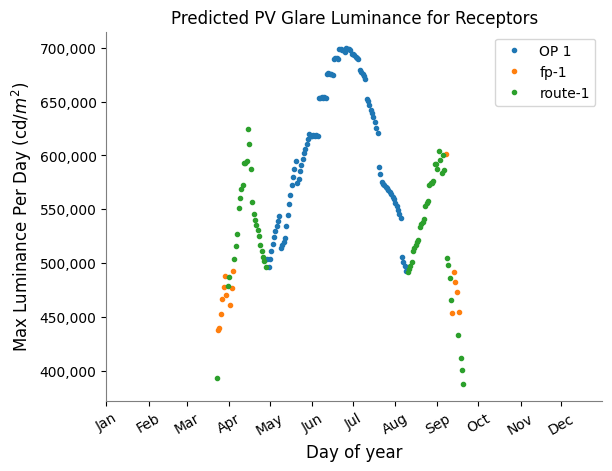
Why it matters: A PV module is not a mirror. Its surface has a microscopic slope error, so reflected sunlight leaves as a spreading cone rather than a single ray, and that spread determines both where glare lands and how intense it is. A tool that treats reflection as perfectly specular, or omits beam spread entirely, will misplace glare and misjudge its intensity. Both errors carry consequences: one produces a clean report for a site that will glare, the other blocks a viable project over glare that will not occur.
ForgeSolar: The glare cone is computed from the angular size of the sun together with the module's surface slope error, and reflected luminance is modeled rather than assumed. Product-specific reflectance profiles are built from laboratory BRDF measurements, so an analysis can reflect the module actually specified rather than a generic ideal surface.
Does the result record which version produced it?
Why it matters: Analysis engines change as the underlying science improves, which is appropriate. What matters is whether a given result can be attributed to a specific version, and whether the vendor documents what changed between versions. Where the physics is updated silently, two studies of the same site can disagree with no way to account for the difference.
ForgeSolar: Every stored analysis records the engine version that produced it, and each change to the radiometric calculations is documented in a public engine changelog accompanied by a methodology memo.
Is the method familiar to the authority reviewing the project?
Why it matters: Introducing an unfamiliar method into a review costs schedule. A reviewer who recognizes the methodology can evaluate the project; a reviewer who does not will evaluate the software first.
ForgeSolar: FAA policy required this methodology by name from 2013 until 2021, and hundreds of analyses built on it have been accepted in FAA review. Several non-US policies are modeled on that same 2013 policy, some of them extending it to departure paths and custom flight tracks. Our users file these reports for aviation, highway, rail, and residential permitting worldwide. See FAA solar glare policy for what current policy does and does not require.
Does the output show where and when glare occurs?
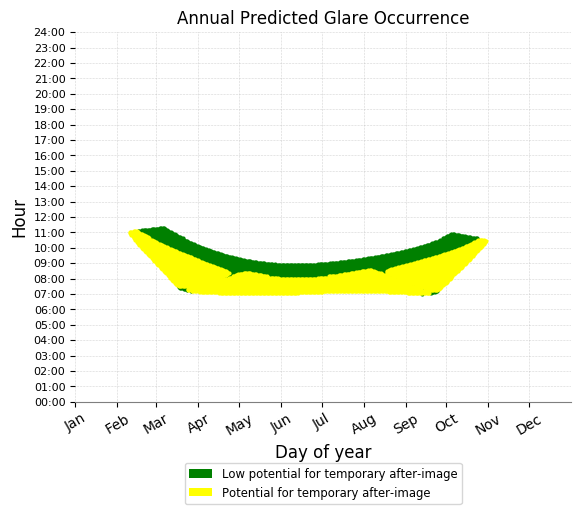
Why it matters: A finding of no predicted glare is a conclusion, not evidence. A defensible study presents the geometry, the receptors, the analysis period, and the predicted occurrence, so that a reviewer can examine the assumptions rather than accept a summary.
ForgeSolar: Each analysis returns per-receptor results, annual glare timeseries, hazard plots, and the site geometry as entered. Any input can be adjusted and the analysis re-run to establish what drives the outcome.
Who answers when the results are questioned?
Why it matters: Glare results are frequently challenged, by a reviewing authority, a neighboring property owner, or an opposing consultant. At that point the question is technical, and it needs an answer from someone who can speak to the underlying physics.
ForgeSolar: Questions are answered by the team that co-developed the methodology, and most are answered the same business day. Professional review services are available where a project calls for an independent assessment on the record.
Cost
Glare analysis is a minor line item on a solar project. The costs that matter are downstream of it: a study a reviewing authority declines to accept adds a permitting cycle, and a glare problem identified after construction requires remediation on installed hardware.
Analyses can be run on ForgeSolar at no cost, so the output can be assessed against the questions above before any commitment. See pricing.
How We Count These Numbers
The figures used elsewhere on this site are derived as follows, as of August 2026. Each is rounded down; the underlying counts are higher.
- 3,100+ organizations
- Distinct non-consumer email domains that have run at least one analysis. Registrations that never produced an analysis are not counted, and personal email domains are excluded rather than counted as organizations.
- 110,000+ analyses
- Total glare analyses run on the platform.
- 20+ GW of solar capacity, 2026 to date
- A lower bound rather than an estimate. One capacity figure is held per project: the total rated power of its arrays where that was entered, otherwise a value derived from the PV area drawn on the map. Across 1,500+ projects created in 2026 to date, those figures sum to roughly 30 GW, against a published 20+ GW.
- The difference is intentional. An area-derived figure depends on how much ground the customer drew, and glare analyses are generally drawn generously, since an over-large array is the conservative assumption when the question is whether a site can produce glare rather than how much energy it will generate. The published figure is set near a third of the arithmetic for that reason.
Corrections are welcome. If any of this looks wrong, let us know.
Apply the Questions to ForgeSolar
3,100+ organizations in 110+ countries have run 110,000+ analyses with ForgeSolar as of August 2026. Run one and assess the output directly.